
In Scripture, the Greek word ergon is used to mean works. But contextually there are different types of works. Without this understanding we can tend to think that all works are either worthless or anathema before God. Furthermore, understanding works is critical to understanding passages such as Ephesians 2:8.
Works (Hebrew abad, ashah, and melakah, Greekergon) in Scripture are most often referred to by the modern church as generic works, failing to distinguish between the different types of works as revealed in a lexicon. This gets us in trouble in many ways. For example, Huldrych Zwingli (of the Reformation) declared that baptism cannot be required for salvation not just because of the thief on the cross (which is errant since he was under the Old Covenant) but also because baptism is a work. But what kind of work is baptism? We shall answer this later. Works are divided into three things Scripturally.
- Works of the Flesh: These are the works that man does before coming to Christ. It should be noted that there can actually be works done before coming to Christ which are righteous, but it is likely these are few and far between. Many, and i would suggest most decisions we will make before being indwelt by the Holy Spirit have a selfish motive. They serve no value at all. Although in context about Israel, these are the filthy rags referred to in Isaiah 64:6.
- Works of the Law: These are works of the law, that is doing what the law demands of us. It generally ascribes to the letter of the law. Unfortunately, we cannot fully and always keep the law (this is course would include the civil, ceremonial, and moral parts of the law). We must not place our trust in trying to keep the law. If we somehow could keep the law fully and always, we could be saved by it. But Scripture is pretty clear that we cannot do this (Romans 3:20). However, our Lord and Savior did exactly this. He came to fulfill the law and after doing this, became the source of salvation for us.
- Works of God (or the Spirit) are the works that God commands and expects us to do. These include things like faith, repentance, confession, loving God, loving others, sharing the gospel, and baptism. Furthermore, after we are indwelt with the Holy Spirit, the Holy Spirit leads us to perform works that bring glory to God. In this case, these works are righteous (ex. 1 John 3:17, John 15:1-6, Revelation 19:8, etc.). It should be noted that in Revelation 19:8, the KJV renders this righteousness which some misunderstand to be the righteousness of Christ. However, a lexicon makes it clear these are righteous acts or deeds.
The modern idea is that most of what Paul spoke about were the works of the law and trying to maintain the works of the law for salvation as foolish as is trying to justify before God why he should save us based on our works when coming to Christ. This is critically important because if we understand all works to be generic, then we discount and indeed rebel against what God explicitly tells us to do. Baptism is one such example. It is a work of God that we do. It is a righteous work because it involves submitting to God and His desire for us to submit to His leading.
Below is a diagram that demonstrates the difference in works before and after coming to Christ. When we exist before coming to Christ, we are consumed with the works of the flesh. We do not seek to bring glory to God through what we do. Yet while in the flesh, there are times when we are both committed to, and actually do, works according to the law. These meet God’s standard of righteousness. The problem of course is that God’s standard is perfection and the law is here is taken as a whole; that is failing at any point of the law results in failing the whole law. We are taught “For whosoever shall keep the whole law, and yet offend in one point, he is guilty of all” (James 2:10). Hence, if we sin just once in our life we are separated from God; an insurmountable barrier for a mere human. But enter God. Once God enters our life and we come to Him in faith, we inherit Christ’s righteousness; that is we are declared righteous.
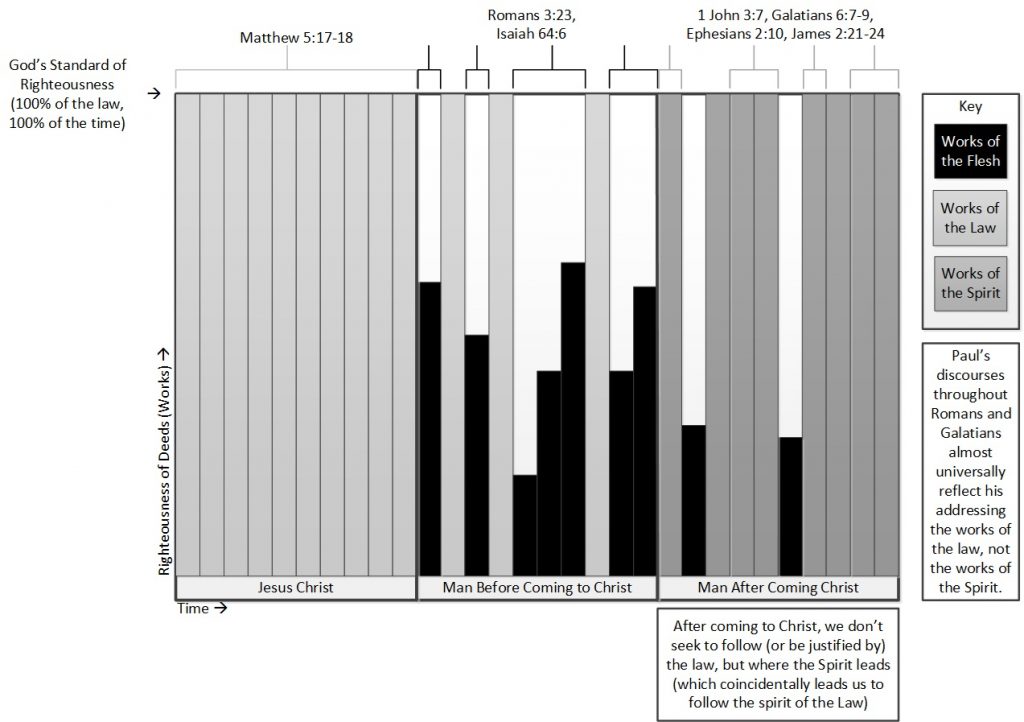
Different works during differing phases of life; comparison with Christ
It must be stressed that the grace of God is needed regardless of what we have done before coming to Christ. The reason for this is clear. Grace is unmerited favor. To merit God’s favor, we must be perfect before God in keeping what He has entrusted to us. Any of us who have not met God’s standard require God’s unmerited favor (grace). That does not mean that before coming to Christ there were some who were better and worse, just that none meet God’s standard so we all need His grace.
But once we have come to Christ and are given the gift of the Holy Spirit, we are to follow where He leads. Now we replace our desire to follow the flesh and the law with the desire to follow the Holy Spirit who leads us to keep the spirit of the law, not just the letter of the law, for the letter kills but the spirit gives life. But this does not in any way excuse us from the works as the Spirit leads us as many would tell us.
There are many passages, which specify the need of work; these are the works of the Spirit, the works of God through true believers. Some of these have eternal implications in that they demonstrate the presence of the true faith required for salvation. These include: Galatians 5:6, 6:7-9, Romans 2:6-8, John 5:28-29, Ephesians 2:10, 14, James 2:14, 20, 24, 26, Philippians 2:12-13, John 3:21, 15:1-6, 1 Corinthians 15:58, Acts 10:34-35, 19:18, 26:20, Romans 8:13, 1 John 2:17, 29, 1 John 3:7, 10, 17, Titus 1:16, 2:7, 2:14, 3:8, Revelation 2:5, 3:1, 15-16, 12:17, 14:12, 21:8, 2 Timothy 3:17, Hebrews 10:24, and 1 Peter 1:17.
It should be noted that in Scripture, all cases where the eternal destiny of a person is decided it is based on works with the exception of the thief on the cross (who was technically under the Old Covenant) but who did everything he could in his circumstance. In all of these, there is no mention of faith. Let me restate that again: in Scripture all cases where the eternal destiny of a person is decided it is based on works with no mention of faith. That does not mean that faith is not important but rather that works are the natural and spirit-driven outcomes of a true faith.
Again, this is important because in Romans, Galatians, and other books, Paul’s (God’s) reference to works is works of the law. This dramatically changes the meaning of the passages. With this understanding, no longer does it condemn works, but only condemns in trying to save one’s self by the works of the law. This is what Scripture teaches. Furthermore, the modern church has taken this even further to suggest obedience is works, another idea that is untrue. How does God define who are his true followers? Consider just a couple of passages:
SCRIPTURE John 10;27 “My sheep hear my voice, and I know them, and they follow me,”
SCRIPTURE Revelation 14:12 “Here is the patience of the saints: here are they that keep the commandments of God, and the faith of Jesus.”
This is one of the most misunderstood of all errant doctrines in Christendom. Many denominations and most evangelicals make a critical error; they see all works as the same which an understanding of Scripture does not lead us to. In doing so, we see one of the critical sources of rebellion against God. When a person is taught that all works are the same, that we are saved only by faith, and combine this with the idea that salvation is an instantaneous event (as we show elsewhere on this site) they become convinced that whatever they do means nothing, either good or bad. Once a person becomes convinced that nothing they do, has anything to do with their salvation, they embrace the same thing Israel did during the time of the judges when we are taught “every man did that which was right in his own eyes” (Judges 21:25b).
In fact, many sayings of men come from this errant idea. Here is an example of one from Luther’s full letter to Melanchthon, with an oft-used quote in its original context:
“If you are a preacher of mercy, do not preach an imaginary but the true mercy. If the mercy is true, you must therefore bear the true, not an imaginary sin. God does not save those who are only imaginary sinners. Be a sinner, and let your sins be strong (sin boldly), but let your trust in Christ be stronger, and rejoice in Christ who is the victor over sin, death, and the world. We will commit sins while we are here, for this life is not a place where justice resides. We, however, says Peter (2 Peter 3:13) are looking forward to a new heaven and a new earth where justice will reign. It suffices that through God’s glory we have recognized the Lamb who takes away the sin of the world. No sin can separate us from Him, even if we were to kill or commit adultery thousands of times each day. Do you think such an exalted Lamb paid merely a small price with a meager sacrifice for our sins? Pray hard for you are quite a sinner.”
While many debate what Luther was actually trying to say to Melanchthon, the essence of what was said is clearly dangerous when contrasting it with the breadth of Scripture.
It also does not mean that because we follow the Holy Spirit, we trust in our works instead of Jesus Christ. This is often one of claims of those who have misunderstood what true faith is. Sometimes those who want to use their freedom in Christ to focus on themselves often claim that anyone else who claims that a person must follow where God leads to be His servant, means they believe in works-based salvation. Simply, Scripture is clear about the relationship between faith and works yet many pastors today gloss over this as shown by the claims of their followers.
The works that God wants us to do are those led by the Holy Spirit. This also includes the works of the law, not because we are following what the letter of the law says, but because we follow where the Holy Spirit leads for “Who also hath made us able ministers of the New Testament; not of the letter, but of the spirit: for the letter killeth, but the spirit giveth life” (2 Corinthians 3:6). We are also reminded that the two great commandments also embody all the law and the prophets “Teacher, which is the greatest commandment in the Law? Jesus replied: Love the Lord your God with all your heart and with all your soul and with all your mind. This is the first and greatest commandment. And the second is like it: Love your neighbor as yourself. All the Law and the Prophets hang on these two commandments” (Matthew 22:36-40). It should be noted the Spirit leads us to follow the commandments; not just the letter of the commandments, but the spirit behind them as well. It is literally a salvific issue, that is one affecting a person’s salvation. If a person acts in a manner inconsistent with what they claim to believe, does that person really believe? The modern church says yes, that belief is all that is important but that is not what the breadth of Scripture says. That is works should proceed from a true faith and as discussed above, this is reinforced by what is stated in Scripture as to how a person’s eternal destiny will be determined.