
One of the greatest mistakes that modern teachers make relates to understanding the ideas of Total Depravity and Spiritual Death. Let me start by offering three ideas and then let us see why they are true Scripturally.
Spiritual death is not a condition we are born into.
Spiritual death does not mean the literal death of the spirit within us. It means separation from God.
Total depravity is not true as defined by Calvinists or Reformed theologians.
What does the Bible say separates us from God?
Answer: Our sins (Isaiah 59:2); notice it says nothing about actual death of our spirit but separation; a barrier between us and God. We see something similar in Genesis 2 and 3. What happened when Adam disobeyed? He was separated from God. He did not die physically, but spiritually, that is he was separated from God. Similarly the prodigal son who was alive when with the father died spiritually (but not physically) when he went off to live in sin but was spiritually alive when he returned to the father. Again, separation, not actual death of the spirit.
What does the Bible teach about who is responsible for whose sin?
Answer: Each man is responsible for their own sin (Deuteronomy 24:16, Jeremiah 31:30, Ezekiel 18:4, 20) . Actual sin itself does not pass from person to person although a sinful nature can and does (Romans 5:12). But, and this is critical, a sin nature is not the cause of spiritual death itself; sin is. Over time, the sinful nature always leads to sin which does result in spiritual death in humans, but even that sin is bound by being accountable to the knowledge of right and wrong.
What sins have babies committed?
Answer: None. At the very least, none they are responsible for. Even the passage most closely aligned with the idea of being a sinner at birth probably does not mean what people often understand it to say. In Psalm 51:5, David states “Behold, I was shapen in iniquity; and in sin did my mother conceive me.” What does this mean? Both of these references in this verse state “in” meaning it was not the condition of David himself, but rather the condition of the one who bore him. We might even ask who shapes? In Psalm 139:13-14 we read “For thou hast possessed my reins: thou hast covered me in my mother’s womb. I will praise thee; for I am fearfully and wonderfully made: marvellous are thy works; and that my soul knoweth right well..” Again, it is not the infant themself who is a sinner from birth, but the process and those who actually bore the infant, hence being conceived (something that happens to the infant) in iniquity (or sin). Remember, the idea of actually having a baby assigned sin as soon as they are born is not logical at all and we have already seen that each person is responsible for their own sin. Having said this, it is true we are born with a sinful nature.
Does Paul say he was alive once?
Answer: Yes.
When does Paul say he died?
Answer: When the law came to him (Romans 7:9). Remember that the law had been promulgated some 1,500 years previously. Hence, he cannot be talking about the publishing of the law since he was not alive at that time. Furthermore, he makes it clear in Scripture it was when the law came to him personally that he died. Before this he was alive.
How did Paul die?
Answer: Spiritually; his writings refer to spiritual death. When Paul is talking about this it is during the time he was spiritually alive then died; a time he looked back on. Again, this is not physical death.
What does Paul say about the person who sins when there is no law?
Answer: For without the law sin was dead (Romans 7:8b). Also, in Psalm 14:3, Psalm 53:3, and even Romans 3:12, it states that those who do not seek God and do what is right, became this way, not that they were always this way, nor created this way. The same idea exists in Romans 1:19 for those who “knew God.” These very people who knew the one true God (from the lexicon) chose not to worship Him.
What about those who do not know right from wrong?
Answer: While this is not clear, there are two specific teachings. In John 9:41 we read “Jesus said unto them, If ye were blind, ye should have no sin: but now ye say, We see; therefore your sin remaineth.” Jesus makes it clear that if they did not know they were doing wrong, then there would be no actual sin. In the second teaching, Paul states he was shown mercy because of his ignorance (1 Timothy 1:13). The fact that mercy was needed showed there was still sin, but that there was a temperance because Paul was ignorant. Similar teachings in the OT show that although sin can be committed by the ignorant, the penalties are significantly less.
Who does Jesus say the kingdom of God belongs to?
Answer: Children. In Luke 18:15-16 people were bringing infants and children to Jesus and he plainly tells them that the kingdom of God belongs to those such as these. In the lexicon, “such” refers to “one who is of such a character.”
We are born with a sinful nature but that does not constitute separation from God. When we sin, with knowledge of sin, we are separated from God. I do not say that the sinful nature we are born with is not always spiritually fatal, just that Scripture does not support we are born spiritually dead. Again, the sinful nature we are born with is always spiritually fatal if we live long enough. However, again it does not mean we are born spiritually dead.
In Romans 5:14 we read “Nevertheless death reigned from Adam to Moses, even over them that had not sinned after the similitude of Adam’s transgression, who is the figure of him that was to come.” Death reigns because we have the sinful nature and we eventually give into it and sin. The conditional clause here is important; “even over them that had not sinned after the similitude of Adam’s transgression.” What Adam did (the similitude) was directly violate God’s command. Remember the period this verse covers is from Adam to Moses. The direct commands of God were given to Moses later in the law. Hence, these people between Adam and Moses died and death reigned (but of course not all, ex Noah, Abraham) because they still sinned violating the conscience given to them by God even though it was not a result of His direct commands.
In Scripture God even says he has found good towards Him in a child (1 Kings 14:13). That cannot be if the child was truly spiritually dead. The good in this passage is towards God.
Total Depravity, as framed by some, is a consequence of the fall of man resulting in every person born into the world being enslaved to the service of sin as a result of their fallen nature, completely unable to choose by themselves to follow God. This means that if Total Depravity is true, everyone since the fall must be so tainted. Even those who would rename this to Total Inability must show no one has ever sought God.
We must understand the idea of righteousness. Righteousness is a state. An unrighteous person can do something righteous yet still be unrighteous. A righteous person can do something unrighteous yet remain righteous. Righteousness is a state, not an individual action. In fact, when we go back to Psalm 7 we see David declare himself righteous before God. Yet we know that David sinned as have all men. Having said this, David here is declaring a practical righteousness arising from David’s good faith effort to obey the Lord. But this man who had a heart after God also repented and confessed sin when he did fail the Lord.
The point of this is clear in Scripture. None are righteous according to God’s standard requiring every man to have a savior – no exception. But it does not follow from Scripture that a) no one ever does anything right, nor b) that man is so depraved that he only does wrong. Many Reformists would agree with this.
So the breadth of Scripture does not paint man as totally depraved. Why do we say this? Because we see a number of people in Scripture seeking God before coming to Christ, both in the Old Testament and the New Testament. There are many places that directly and indirectly reference this. Furthermore, those that were seeking, did not always behave as modern theologians think they should in the seeking, hence their idea of seeking is bound by behavior.
But doesn’t Scripture show people seeking God before coming to Christ? Consider just two cases (but there are more).
SCRIPTURE Acts 22:3 “I am verily a man which am a Jew, born in Tarsus, a city in Cilicia, yet brought up in this city at the feet of Gamaliel, and taught according to the perfect manner of the law of the fathers, and was zealous toward God, as ye all are this day.” COMMENTARY Clearly shows that Paul was zealous towards God. This was before he was regenerated. There are two ways. First he denied Jesus Christ. Second, he did not act in a manner consistent with regeneration. In fact, I am sure Paul looked back at how zealous for God Phinehas was (Numbers 25:6-12) and saw himself similarly, even willing to kill for God. Paul even notes the same about other Israelites in Romans 10:2, they also being zealous for God. However, that zeal was not based in knowledge (Hosea 4:6, Romans 10:2). Yet throughout all this Paul was truly seeking God But Paul’s actions did not reveal a regenerated man; he lacked knowledge as he stated in 1 Timothy 1:13 which is why he was shown mercy (Hosea 4:6 – My people are destroyed for lack of knowledge).
SCRIPTURE Acts 16:14 “And a certain woman named Lydia, a seller of purple, of the city of Thyatira, which worshipped God, heard us: whose heart the Lord opened, that she attended unto the things which were spoken of Paul.” COMMENTARY Lydia also sought and worshiped God before coming to Jesus Christ. Here we understand that Lydia was also not regenerated when she was worshiping God. How do we know? God opened her heart to the message that Paul delivered. If she was already regenerated, the message would have been apparent to her. But she also knew nothing about the Messiah.
This is one of the mistakes the Calvinists make; they do not distinguish between seeking God and seeking Christ. Yes Christ is God, but they may be sought separately as Jesus refers to in John. In fact the whole discourse towards the end of Romans 1 is about those that “knew” God but refused to worship Him.
This means that we need to look a little deeper into the idea of not seeking God as stated in Romans 3:11. There are two potential clarifications i can envision but there may be others. It would seem, consistent with the rest of Scripture, that not seeking God likely means either a) not seeking God as He desires, or possibly b) not seeking Jesus Christ specifically since the underlying word for God in Romans 3:11 is Greek theos which can mean the Godhead or any member of the Godhead. Furthermore, Paul also notes that many of his brothers in the flesh (Romans 10:2) share this zeal but not according to knowledge. That means they too are seeking God but not according to knowledge.
There are multiple passages in Scripture which suggest that the first alternative is correct (that is people do not seek God as He desires). These include Psalm 53:3 and Jeremiah 4:22. These people did not seek God because they did not do what is right. But they became this way. In Proverbs 1:29-30, it clearly says these people did not choose fear of the Lord. It does not say they were born that way; it was a choice they made. In Romans 1:22, God tells us “Professing themselves to be wise, they became fools.”
But its not just Paul and the Jews. We must pay particular attention to Lydia in Acts 16. Lydia (Acts 16:14), before God opened her heart, was known as a worshiper of God (note the worshiping of God preceded the opening of her heart). The opening of her heart was to the message but clearly she worshiped God before coming to faith in Jesus Christ.
Also, Cornelius sought God and was noted as a devout man before coming to Christ (Acts 10:1-4). There are others in Scripture as well, without even going back to the Old Testament, that sought God before coming to our Lord and Savior. Remember here that the seminal event that causes separation from God in Calvinistic and Reformed theology is “the fall.” That means, according to Calvinistic and Reformed theology that everyone after the fall is “totally depraved.” Its simply not true as they define it.
In Acts 18:7, we are told Paul entered the house of a man named Justus who was what? He was also a worshiper of God.
In fact, the only way Reformed Theologians can try to make the concept stick is to claim that everyone in Scripture who can be shown to be seeking God. was regenerate long before they came to Christ. However, as we saw, with Paul this fails. If Paul were regenerate when he claimed to be seeking God, he certainly was not acting in a regenerate manner. Furthermore, Paul explicitly tells us, inspired of God, why he was shown mercy. Was it because he rejected God? No. Paul tells us “Even though I was once a blasphemer and a persecutor and a violent man, I was shown mercy because I acted in ignorance and unbelief.” (1 Timothy 1:13). It was not that Paul was not seeking God, nor worshiping God but because of ignorance. Remember this theme carries over from Hosea 4:6a where we are taught “My people are destroyed for lack of knowledge.”
Consider also what God says to us in Romans 1:19, “Because that which may be known of God is manifest in them; for God hath shewed it unto them.” God reveals himself and those described in Romans 1 knew God from this; that is what Scripture says. Two verses later God says specifically that “Because that, when they knew God, they glorified him not as God, neither were thankful; but became vain in their imaginations, and their foolish heart was darkened.” They became vain; a transition, not something they always were. Furthermore, they did not glorify God, meaning they did not seek God as He desired; that is they did not worship Him. But even in Romans 3:12 it says “they became unprofitable”, not they were born this was. This reflects the same language of Psalms 14 and 53 where there is a transitional verb that describes them.
In fact, this is the pattern shown throughout Scripture. Not that God summarily decides a persons future by causing them to rebel against Him or submit to Him, but that God does harden when people rebel against Him and He is perfectly just to do so. That is the context of Romans 9:14-15. Consider these situations.
- Pharaoh
- Nebuchadnezzar
- God’s elect Ancient Israel
- The clay in Jeremiah 18
- The likely Gentiles of Romans 1
- The Israelis in Romans 9
In each of these situations God responded to men who refused to submit themselves to Him. None of these people started out condemned by God. In fact, in all of these situations, God actively tried to lead these people to do His will. It was their refusal which resulted in God’s will be exerted on them. This is why God is not unjust to punish those who refuse to submit to Him.
We should also at least consider that the quote in Romans 3 comes from two Psalms (14 and 53) where the context is clear. It is the fool who says “there is no God.” Even though God inspired Paul to write this, the original context is specific. In both of these Psalms, the situation is the same as those above; that is they became this way but were NOT created this way. In fact, a careful reading of most passages related to this topic show that people became this way but were not created this way.
Remember also the idea presented in Proverbs 22:6 “Train up a child in the way he should go: and when he is old, he will not depart from it.” Many of us understand that God is clearly telling us here that training a child about God and in the ways of God leads them to remain in God. It does not mean they don’t need Christ but as many have seen in our families, when we are diligent about teaching our children about God, they from their youth, often grow up to love God. If the training was of no value and only God’s action was relevant, this proverb makes no sense.
Finally there are many passages in Scripture which do not seem to make sense if one is totally depraved and cannot understand spiritual things. I will not take the time in this section to review why each of these cast a shadow over the concept of total depravity and the associated spiritual death and associated blindness. Examples of these verses are Isaiah 66:3b, Matthew 13:36-39, John 5:40, Acts 17:30, Romans 1:19-21, 2:14-16, 10:21, Acts 17:26-30, 2 Corinthians 4:4, Revelation 22:17.
In short, the idea that no one seeks God as stated in Romans 3:11 must be considered in context with the breadth of Scripture to try to harmonize all Scripture. While there may be other alternatives than the ones provided (not seeking God as He desires, or not seeking Jesus Christ specifically) the idea that no one ever seeks God at all does not align with the breadth of Scripture.
Here is a diagram that shows the logical implication of what is stated by the Reformed. Remember this is according to Reformed Theology. If we look at what Calvin himself taught, he believed in double predestination (and actually Reformed people logically believe in double predestination whether they will admit it or not), which is that God actively picks and chooses who will be saved and who will be lost.
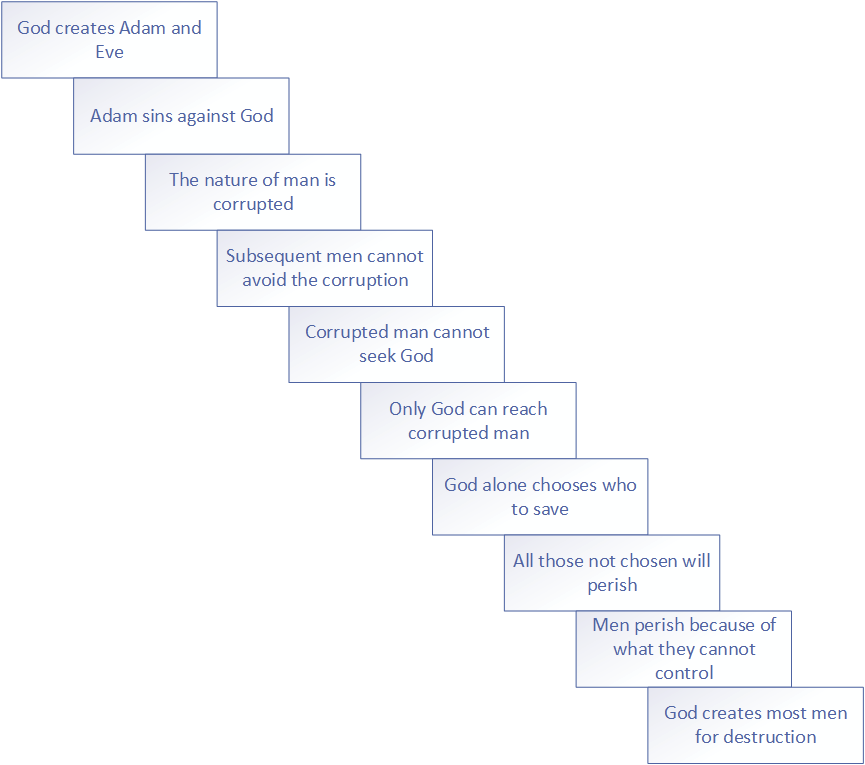
Diagram 1
Notice here that man’s ultimate destruction destination has nothing to do with anything they choose to do or have chosen to do in Reformed Theology. They are a product of that which was inherited by them through no fault of their own. Furthermore, since God only chooses to call some in Reformed Theology, these men are willingly left to what they inherited. We must ask: is this truly just? Can anyone reasonably hold a person responsible for a condition they inherited that they cannot control? Remember that God can do anything EXCEPT violate who He is. Our God is just. In the end, the Reformed idea of Total Depravity is simply not logical or Scriptural.