
The idea of eternal security (and here we mean the concept of guaranteed, unconditional eternal security) is a relatively recent doctrinal invention. It was largely introduced and formalized by Calvin who introduced a systematic theology which incorporated this idea [1] although there were groups such as the Gnostics who embraced this concept. Within Reformed and Calvinistic frameworks, where the sovereignty of God is misunderstood, we can see how such a doctrine might develop. Yet it was not a part of orthodoxy for the first 1,500 years of the church. Even Augustine did not fully believe it. Yet in today’s churches we often see the doctrine promoted apart from the remainder of the framework. The belief in guaranteed, unconditional security embraced by some includes that security even when apostasy, unbelief, or living in persistent rebellion to God occur. In Scripture, there are passages which address our security and passages which warn us. There are also passages which place conditions (enduring, overcoming, living, etc.) on our final or future salvation (which is essentially enduring faithfully to the end). Thus, we have security in Christ, but it is neither guaranteed, nor unconditional. It should be noted that every separation from God occurs at the hands of men who exert their free will in opposition to God. It is clearly shown in Scripture, that God does act to preserve us, but God does not override the free will He has granted us which is why the clear warnings in Scripture exist. As we look into this errant doctrine, we must examine a number of ideas across the breadth of Scripture.
Before we examine Scripture, it must be stated that salvation is not an on-and-off again proposition. That is we do not, over a short period of time, vacillate between saved and unsaved. There are two primary ways we turn away from the Lord. The first is to outright deny Him. This is a turning away from the Lord which many over history have done (turning back to the law to justify ourselves would fall into this category). The second is to live in a manner that continues to oppose the will of God. It is not a single sin (except for the single sin leading to death mentioned in Scripture) but rather a pattern of continued and willful disobedience (ex. Hebrews 3:12-13), often focusing on engaging the flesh, which results in turning from the living God. The latter occurs over time when one experiences increasing hardening arising from the deceitfulness of sin. As Paul clearly explains in multiple epistles, it is refusing to follow the Spirit and instead focusing on living in the flesh.
- We have a free will after coming to God (although there are those who debate whether we have a free will before), yet Adam and Eve, Abraham, Moses, Joshua, the Israelis, the Prodigal Son and many others throughout Scripture demonstrated free will. God told the Israelis to “choose” life over death; Joshua whom they will serve. The entire nature of Scripture attests to it. There are commands, pleas, and warnings all of which are unnecessary if we are controlled (or irresistibly led). As such, we are led by the Holy Spirit, not controlled. God acts to preserve the believer as He did with His chosen people, most of who were destroyed, however He does not control people as a normal rule. The single greatest evidence of this is that the believer continues to sin. Our God is holy, holy, holy. The Holy Spirit within us is God and leads us away from sin, yet we still do it. God will discipline us but God’s discipline is not always effective (Amos 4:6-11). God could have simply disciplined, rather than killed, Ananias and Sapphira if His discipline was always effective. Many times, God’s chosen people, the Israelis, did not respond to correction and were destroyed. When God told Ezekiel (Ezekiel 2) to confront His chosen people, God acknowledged to Ezekiel they may or may not listen to the correction. The same occurs in Jeremiah 5:3-5.
- Salvation, as we have seen elsewhere, is a both a state and a path, but It is not an instantaneously completed event (Matthew 7:13-14, 1 Corinthians 9:24-27, Hebrews 12:1). Notice in Matthew 7:14, eternal life is after the strait (or small) gate and after the narrow path. We set out on the path beginning with our faith in Jesus Christ. He is the strait (or small) gate (John 10:7) we enter through, but we still have the narrow path to navigate which leads to eternal life (Matthew 7:14). Notice that if everyone who entered through the strait (or small) gate would remain saved, the path after the strait gate would also be broad; it is not. The idea of a path is also acknowledged other places in Scripture including the verses above. Just as in an earthly race, when we cross the start line, we are in the race, but we have not finished it. When we are given the Holy Spirit as an earnest or deposit (Ephesians 1:14), this legal language guarantees God will be faithful to His part of the covenant if we will be faithful, just as in a legal transaction. Yet, it also means we have not fully received what is to come otherwise there would be no reason for a deposit. Even Jesus taught us directly “And whosoever doth not bear his cross, and come after me, cannot be my disciple” (Luke 14:27). Here, “Come after me” is again in the continuous present tense; again a path. Almost every place in Scripture, faith (pisteuo) is rendered in the continuous present tense telling us initial belief is not the end of the story. Salvation is from the Lord for we cannot save ourselves, however we must cooperate with God by following His Son through the leading of the Holy Spirit. Such is the nature of a covenant. Again, there is no reason for so many commands (imperatives), pleas, and warnings if God is doing everything. The number of active verbs where man is the subject in Scripture is extensive. In Scripture, salvation is spoken of in three tenses by definition and by context (even though the Greek words below reflect a mix of both verbs and nouns). It is spoken of in past tense (Ephesians 2:8, 2 Timothy 1:9 ), present tense (Hebrews 2:3 (soteria), Philippians 2:13 (soteria)), and future tense (Matthew 10:22, Romans 5:9, 1 Corinthians 5:5). In each of these cases, the underlying words for salvation (root: sōzō) means salvation, not justification (dikaioō), nor sanctification (hagiasmos), nor glorification (doxazō). That does not mean that we are not justified, sanctified, and eventually glorified if we remain faithful. This is highlighted in Hebrews 3:14 “For we are made partakers of Christ, if we hold the beginning of our confidence stedfast unto the end.” Another demonstrative passage of future salvation is in Hebrews 9:28, where salvation (sōtēria) means “future salvation, the sum of benefits and blessings which Christians, redeemed from all earthly ills, will enjoy after the visible return of Christ from heaven in the consummated and eternal kingdom of God.” In this light, loss of salvation is more related to not completing the race or deviating significantly from the narrow path.
- Salvation leads to eternal life. Salvation, in and of itself, is not eternal life. We are saved from not only separation from God, as well as the wrath of God, but also from the power of sin. Consummation of eternal life is reached at the end of our lives if we stay on the narrow path (remain saved) as in Matthew 7:14. We take hold of the true life through our actions here (1 Timothy 6:19). Although Jesus Christ gives us eternal life even now (John 10:28), that life is not consummated until we finish this life (several theologians term this as “already, but not yet”). In fact,Galatians 6:8 demonstrates this quite clearly where the “reaping” of eternal life is a future tense verb, dependent on what we sow to during our time here on earth. Romans 6:22 clearly states eternal life occurs at the end resulting from our fruit unto holiness. In Hebrews 5:9 we are taught that Jesus is the author of eternal life for those that “obey Him” showing that the eternal life is dependent on obedience. As we will see immediately following this, the awarding of the consummated eternal life occurs at judgment.
- The determination of who enters into eternal life is stated throughout Scripture, and is based on what one does with the faith they have (or their lack thereof), meaning it cannot be based on initial faith alone. Those conditions are reliant on how we live our life (Matthew 25:14-30, 31-46, John 5:28-29, John 15:1-6, Romans 2:6-8, Galatians 6:7-8 and even Revelation 2 and 3 where in the KJV, the words of Jesus to each of the churches start with “I know thy works”). In Galatians 6:7-8 God tells the Christians in Galatia that they will reap (again, future tense) either corruption or eternal life, based on what they (active verb) sow to (the flesh or the Holy Spirit). Even the definitions of who are God’s people and who will receive eternal life reflect this (John 10:27, 15:10, Romans 6:16, 15:18, Revelation 14:12 and even Hebrews 5:9). These verses clearly show that eternal life is not fully consummated at initial faith. The idea of faith alone applies to initial salvation; that is we do not come to God deserving to be saved based on whatever parts of the written law we may have kept. It is by His grace through faith alone. Thus, salvation begins entirely by God’s grace and is received through faith, but the faith that receives God’s grace enters a life of obedience, good works, perseverance, and continuing trust in Christ. We we are to listen to and follow where our Savior leads (John 10:27) through the Holy Spirit. The works we are to do are not the works of the flesh, nor the works of the law (as Paul almost always speaks of, especially in Romans), but the works of the Spirit (see immediately below). Furthermore, those who think if they do any works or deeds, they are “earning their salvation” (often misnamed “works-based salvation”), misunderstand the concepts of “earning their salvation” or “works-based salvation.” The only way for a human being to earn their salvation would be to keep 100% of the law, 100% of the time and as we are explicitly told (ex. Romans 3:20), none are able to keep the law to salvation. We need never ask how much we should do. That is the question of someone who is being legalistic, trying to determine the minimum they must do. Instead we are to consistently serve our Lord.
- Most of modern Christianity misses the difference in works within the Old and New Covenants. As stated above there are three different types of works in Scripture, works of the flesh, works of the law, and works of the Spirit. Works of the flesh never could save. We are no longer under the Old Covenant which required compliance with the works of the law (however, not as a saving mechanism since no one could fully keep it). Under the New Covenant we are now under the leadership of the Spirit who assists in following the moral elements of the law and not just the letter of the moral law but the spirit of the moral law. However, failure to follow the Spirit is spiritually fatal if we do it enough. We see clear teachings about this in Galatians 5:19-21, Galatians 6:7-9, Romans 8:1 (in the correct KJV version), 8:4, 13-14, and others. This is the reason we are taught “But if ye be led of the Spirit, ye are not under the law” (Galatians 5:18). Notice the condition “if ye be led”. However, just as with a bandleader, if we are not following, we are not being led. We, as new creatures, under the New Covenant, should be committed to follow the Spirit, not the letter of the law. However any idea that we can reject where the Spirit leads with impunity is errant. It is also why many places in Scripture, loving God and following Christ is associated with following the commandments (ex. John 14:15) because it is where the Spirit leads us.
- Justification is always based on an act or acts whereas sanctification is an internal transformation, not based on acts. Why do i mention this? Because some believe that the acts we do after coming to Christ form the basis of sanctification. However, justification is act-based whereas sanctification is an internal transformation. Sanctification does lead to ongoing justification because the internal transformation leads us to act as God desires. Justification is initially based on faith alone (Romans 5:1, James 2:23). Once we have come to faith it is further based on how we act in faith (James 2:21, 25) as we are transformed, if we will submit to the Holy Spirit (Romans 12:2). Biblical faith does not remain barren. Salvation originates in the grace of God and is received through faith, but biblical faith responds to God through obedience and loving others. At least two verses directly clarify that justification is tied to faith (Romans 3:28, Galatians 2:16). These are both (faith, justification) continuous present tense verbs and establish that justification although an initial declaration, is not the end of the story otherwise the verb for justification would always be perfect tense verbs (done once with continuing effect). The idea that one remains justified regardless if they abandon the faith, or practice willful sin, is not Scriptural. It must be stated that we cannot be fully justified by our works, ever. However, the root of justification is righteousness and we can do righteous things (Romans 2:10, 1 John 3:7, Revelation 19:8) as we follow the leading of the Holy Spirit (not the letter of the law) and these acts contribute to our righteousness, yet never righteous enough in and of themselves, to save ourselves. However, I restate what is clearly taught: we can never do enough righteous acts to save ourselves. The only person who lived a perfectly righteous life was our Lord and Savior. Faith remains the basis of salvation. If we trust in our righteous acts to save us, we are trusting in our own righteousness and we are stumbling over the stumbling block that many Jews have (Romans 9:32). Again, we must never trust in what we do to save us. It would mean that Christ died for nothing. Yet this does not exempt us from doing these righteous acts as God commands and leads us into (Ephesians 2:10). Righteous acts come from willingly following the Holy Spirit by submitting to God and sowing to the Spirit (Galatians 6:8). Finally, as our Lord taught us “So likewise ye, when ye shall have done all those things which are commanded you, say, We are unprofitable servants: we have done that which was our duty to do” (Luke 17:10).
- The promises of God are received through faith; a true and living faith (Hebrews 6:12, Hebrews 11:33). Hebrews 8:6 says that the new covenant is based on “better promises.” This alone refutes the idea that the promises of God are absolute at an individual level. God fulfills His promises, but those to whom the promises were given, do not always receive them. Others throughout Scripture, including God’s chosen people the Israelis, have not received the promises of God. Those elected or chosen are not always saved (and elected is probably not what many think it means). Paul was greatly troubled because his people, God’s chosen, were not all saved (Romans 9:2-3). We are warned three times in the New Testament to not follow the examples of the Israelis (1 Corinthians 10:1-12, Hebrews 3:7-4:11, Jude 1-5) who absolutely knew, through first hand experience, that God existed but they did not submit to Him. Remember even the demons believe but do not act (James 2:19). True faith is not simple belief. It is something so deeply rooted in a person that it changes their actions to align with what they believe. But we can give up our faith; that is no longer believe (or act) in the way we once did, hence the warnings in Scripture to endure and overcome. Again, belief manifests in action. In Hebrew, faith (אֱמוּנָה) is actually more about what one does rather than what one knows. To have faith is to act: “but the just shall live by his faith” (Habakkuk 2:4b); again, the just shall live by his faith.
- Although all sins for everyone have been paid for through the shedding of the blood of Christ, our unrighteousness is cleansed on an ongoing basis using the blood of Jesus Christ (1 John 1:7-9) as these are continuous, present tense verbs. Similarly we are forgiven sins on an ongoing basis (again Matthew 6:14-15, Luke 6:37, James 5:15, 1 John 1:7-9), again in the present tense. Notice in 1 John 1:7, the condition for this forgiveness is walking in the light; something unbelievers cannot do. There is no place in Scripture where God has forgiven sins in advance of their actual commission. Even in Hebrews 4:16 we are told to “approach the throne of grace with confidence” so that we might be shown mercy showing that mercy is dispensed not once in advance but as we sin. Jude 21 reflects a similar idea. Forgiveness comes with humility before those we have offended. God warns in Scripture about those He will not forgive (ex. Joshua 24:19, 2 Kings 24:4, Jeremiah 5:7, Lamentations 3:42-43). Both payment of sins and forgiveness for sins are required for salvation and the resulting eternal life. We are taught the one sin (blasphemy of the Holy Spirit – Matthew 12:22-32, probably 1 John 5:16) although it was paid for (1 John 2:2), would not be forgiven; it was an eternal sin.
- Scripture is clear that we can fall from grace (Galatians 5:4) and fail the grace of God (Hebrews 12:15). In Galatians 5:4, fallen is Greek ekpiptō meaning to fall from a thing, to lose it (in context here is the grace of God). While the passage in Galatians 5:4 (with the context set in v3) is related to returning to relying on the legal constructs of the law to establish our righteousness, this is yet another way we can separate ourselves from the grace extended us. This in essence is turning away from Christ and back to the law. In Hebrews 12:15, “fail of the grace of God” means “fail to reach the goal; fail to reach the end; a.k.a. fail to be a partaker.” God warns about those who turn God’s grace into lasciviousness which can only be done if one had God’s grace at one time (Jude 4). God warns of this and other possibilities because they are real.
- Salvation by grace through faith is a gift, however it should be clear that if a person is given a gift, they may throw it away, yet that does not change the fact it was a gift. A gift not used or thrown away has limited or no value. We should be profoundly grateful for what the Lord has given us. We should not trivialize, abuse, or throw away the gift. There are examples in Scripture, where gifts given by the Lord come with conditions. Jericho was given to the Israelis but they still had to obey the condition God set to have the walls fall. The lives that Paul were sailing with, were graciously given to him by the Lord but the condition was they had to stay with the ship and if they did not, they would not be saved. Salvation comes with conditions even though it is a gift. The idea that we can treat with disdain, the gift of our Lord, is not scriptural nor does it reflect the proper gratitude.
- There is no question that the warnings in Scripture are written to believers. Unbelievers do not regularly read Scripture, but in addition, the context of the warnings makes it clear to whom they are written. Some would say an unbeliever cannot truly understand Scripture anyway. There is no reason for God to warn believers about something that can never happen, especially when there are explicitly stated consequences. Most of these warnings to Christians are directly related to the potential loss of salvation or eternal life. A recurring theme within some of these warnings is to not fall asleep and actively watch for the return of our Lord (Matthew 24:44, Luke 12:40, 1 Thessalonians 5:2-4, 2 Peter 3:10, and Revelation 16:15). The modern church’s view that once one is saved they are always saved empties these warnings of their doctrinal force. To believe that the warnings given of God, especially when there are specific outcomes stated, are irrelevant or impossible, calls God dishonest.
- Scripture easily refutes the idea that those who fall away were never saved. There are many transitional verbs in Scripture. These verbs emphasize a change in state and many relate directly to salvation. One cannot fall away from something they were never a part of (Matthew 13:21, John 16:1, Hebrews 6:4-6, 2 Thessalonians 2:3). One does not drift away (or let slip) the things of salvation unless they had them (Hebrews 2:1). One cannot die spiritually unless one starts out spiritually alive (Romans 6:16, Romans 8:13). One cannot be cut off from a plant or vine they were never part of (John 15:2, Romans 11:17). One does not depart from something they were not a part of nor depart a place they never were (1 Timothy 4:1, Hebrews 3:12). One cannot fall (not to be confused with stumbling which is not a fall) unless they were standing upright (1 Corinthians 10:12, 2 Peter 1:10, 2 Peter 3:17). One cannot abandon their first love unless they had a first love (Revelation 2:4). One cannot be disqualified or cast away if they were never qualified nor a part of something (1 Corinthians 9:27). One cannot be entangled again in something again if they had not escaped (2 Peter 2:20). One cannot endure in something if they were never a part of something (Matthew 24:13, Hebrews 10:36). One cannot turn away from a given thing if they are already turned away from it (2 Timothy 4;3-4). One cannot be overcome if they are already overcome (Revelation 3:21). The hardening of a person’s heart has little effect on an already hard heart (Hebrews 3:8, 13). In fact, these warnings are scattered throughout the New Testament as well as the Old Testament. The list above is only a partial list. Please note that the words in some Bible versions may not correspond exactly to the verbs listed above but the underlying Greek words and their lexical definition clarify the intent. Some of these words are reviewed below.
- We are promised the Holy Spirit. However, we have seen in Scripture the behavior of men drive the Holy Spirit off (He is holy) and God’s people acknowledge that He can be taken away (Psalm 51:11). We have seen the Holy Spirit resisted (Acts 7:51) and are explicitly told not to grieve (Ephesians 4:30) or quench (1 Thessalonians 5:19) the Holy Spirit. Language suggesting the Holy Spirit will be with us forever (John 14:16) is in the subjunctive mood; the mood of possibility (and its actually much more than possibility, but not certainty) and is rendered this way in the Greek and in English in some Bible versions. The idea that the Holy Spirit will remain with us no matter how we act cannot be rationalized with the explicit warnings in Scripture to Christians, nor OT history (it is the same Holy Spirit). Even in places like Deuteronomy 30:6, where the circumcision is performed by God (even as it is now), the text implies that recipients must respond by yielding to His transformative power as does the language in the New Testament. Scholars who analyzed the Hebrew wording note that while God opens the way for this inner change, it still requires a personal response. The new man Saul, which came about when the Holy Spirit came upon Him (1 Samuel 10:6, 10) and God gave him a new heart (1 Samuel 10:9), did not endure in the Holy Spirit and demonstrates this point. As stated above, the Holy Spirit leads us but does not control us. Even Jesus described the Holy Spirit as an advocate, comforter or helper (ex. John 14:16, 26, 15:26), depending on Bible version, but not a controller. There is no place in Scripture where it explicitly says the seal of the Holy Spirit, which is for (not until) the day of redemption, cannot be broken no matter what we do. In fact, the warnings to Christians strongly suggest just the opposite. However, God will be faithful if we are faithful.
- There are at least 16 different words in Greek, with slightly different meanings addressing a different salvific aspect, that by definition, or common historical use, reference loss of salvation and/or eternal life, either directly or indirectly. These lexical definitions are consistent with how they were used in the early church and align with the writings of the early church fathers. Furthermore, the definitions align contextually with the passage. Notice that many of these words also reinforce the idea that salvation is not a simple point-in-time activity. These are contextual definitions. Some people see a list of possible definitions and think I just choose one. But the contextual definition is what matters. Here is one simple example from the lexicon in Blueletterbible.com and also referred to by Strong’s Concordance.
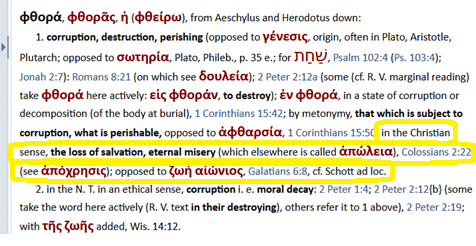
These Greek words are:
phthora means “corruption and in the Christian sense, loss of salvation” (Galatians 6:8)
piptō means “to fall from a state of uprightness” (1 Corinthians 10:12) and “to fail of participating in, miss a share in, the Messianic salvation” (Romans 11:22, Hebrews 4:11).
parapiptō means “to fall away (from the true faith) from Christianity” (Hebrews 6:6)
ekpíptō means “to fall from a thing, to lose it” (Galatians 5:4, 2 Peter 3:17, Revelation 2:5)
ptaiō means “to fail of an objective and to fall into misery, become wretched (often so in Greek writings): of the loss of salvation” (2 Peter 1:10).
apostasia means “a falling away, a rebellion, apostasy” (2 Thessalonians 2:3).
thanatos means “the misery of soul arising from sin, which begins on earth but lasts and increases after the death of the body” (John 8:51, 2 Corinthians 7:10) and “all the miseries arising from sin, as well physical death as the loss of a life consecrated to God and blessed in him on earth to be followed by wretchedness in the lower world” (Romans 6:16, Romans 8:6).
hystereō means “to be left behind in the race and so fail to reach the goal, to fall short of the end; with ἀπό and the genitive indicating the end, metaphorically, fail to become a partaker” (Hebrews 12:15)
sklērynō means “to be hardened, i. e. become obstinate or stubborn” (Hebrews 3:13).
adokimos means “in a moral sense [A. V. reprobate]” (1 Corinthians 9:27). Being reprobate indicates someone who is rejected or unapproved by God.
aphistēmi means to “withdraw oneself from: absolutely, to fall away, become faithless” (1 Timothy 4:1, Hebrews 3:12).
arneomai means “a follower of Jesus who, for fear of death or persecution, deny that Jesus is their master, and desert his cause, [to disown]: followed by Jesus, denying that one is his follower” (2 Timothy 2:12).
apōleia means “the destruction which consists in the loss of eternal life, eternal misery, perdition, the lot of those excluded from the kingdom of God” (Philippians 3:19, 2 Peter 3:16).
pararreō means “let slip” as relates to what we heard of how we obtain salvation [written to existing Christians] (Hebrews 2:1)
apothnēskō means “of eternal death, as it is called, i. e. to be subject to eternal misery, and that, too, already beginning on earth” (Romans 8:13)
skandalízō means “to cause a person to begin to distrust and desert one whom he ought to trust and obey; to cause to fall away,” and in the passive, to fall away (in Matthew 13:21, John 16:1 and others, the verb is in the passive).
We have divided key passages into two different groups. These passages are not meant to be exhaustive but cover the majority of passages used to defend or deny the concept of guaranteed, unconditional eternal security. I will continue to update these over time and your are welcome to suggest improvements or corrections. Each of the links below will take you to that passage and associated short commentary.
[1] James Akin, “Are All True Christians Predestined to Persevere?”, Debate, 1996, “These examples give one a sense of how foreign to Christian history the hypothesis that predestination to grace automatically entails predestination to glory is. Calvin was the first to come up with the hypothesis. No one before him said this. You can check that out for yourself. I did. I searched multiple books and called half a dozen Calvinist seminaries, talking to their systematic theology and church history professors, and no one could name a person before Calvin who taught this thesis. They all said Calvin was the first. I even called John Jefferson Davis, who published an article in the Journal of the Evangelical Theological Society on the history of this doctrine, a man who is himself a Calvinist, but who has researched the history of this doctrine thoroughly, and he said Calvin was the first to teach it.”